
Sessions
Sessions
2026 WGC – Alternate Symposium Meeting Link
A. GTC and Next-Gen Groundfish: AI, Automation, Analytics, and Ethics
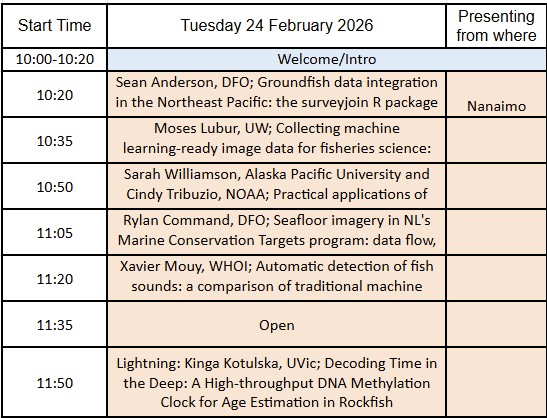
Tuesday morning February 24, 2026. The Canada-US Groundfish Technical Committee (GTC) is hosting a special WGC session devoted to showcasing modern tools, processes, and workflows that enhance our ability to conduct meaningful research on groundfish species. As artificial intelligence (AI) becomes more widespread, and rapid advances in data collection, management, and analysis arise, the world of fisheries research is changing rapidly. This session will showcase how applying AI, technological tools, automation, and reproducible research methods has improved groundfish research by enhancing efficiency, accuracy, and capacity. By sharing these experiences and lessons learned, this session aims to help attendees overcome challenges and find inspiration for advancing their own research efforts. A keynote address will be delivered by Dr. Sean Anderson of Fisheries and Oceans Canada.
Session Chairs: Dana Haggarty (dana.haggarty@dfo-mpo.gc.ca) and Ali Whitman (alison.d.whitman@odfw.oregon.gov)
B. Biology, life history, ecology, and genetics
Tuesday afternoon February 24, 2026. This session focuses on groundfish general biology and life history characteristics. Specific topics may include research on morphology, physiology, anatomy, behavior, evolution, growth, reproduction, and other related topics. Topics may include groundfish spatial distributions, foraging ecology, and relationships with biological and physical attributes of the environment. Topics that examine the interactions of fisheries and habitat are also encouraged. Presentations including eDNA can be included here or in another session depending on the emphasis of the presentation.
Session Chairs: Susanne Mcdermott (susanne.mcdermott@noaa.gov) and Emily Markowitz (emily.markowitz@noaa.gov)
C. Human Dimensions, Policy, and Management
Wednesday morning February 25, 2026. This session focuses on how qualitative and narrative data collection, including oral histories, Traditional Knowledge, and historical ecology can inform fisheries and ecological research. The quantitative data collected from fisheries-independent surveys, commercial fishing landings and observation, and subsistence and recreational fisheries are rarely paired with the qualitative perspective and historical narratives that can capture changes in the ecosystem over time, as well as communities’ experience of and response to that change. Presentations highlighting collection, collation, and archiving efforts; interdisciplinary analyses; and tools for communicating ecological history, and information beyond quantitative data are encouraged.
Session Chairs: Lynn Mattes (lynn.mattes@odfw.oregon.gov) and Emily Markowitz (emily.markowitz@noaa.gov)

D. 50 Years of At Sea Monitoring
Wednesday afternoon February 25, 2026. The rich history of fisheries monitoring illustrates how data collection from large complex fisheries has continuously evolved to support decision making and sustainability of dynamic fisheries. The fisheries-dependent data provided by observer programs and electronic monitoring are of critical importance to a diverse range of analyses that support robust, sustainable fisheries, including stock assessments, quota monitoring, protected species management, ecosystem modeling, and others. The success of these programs is due in large part to the strong collaborative relationships that our monitoring programs have with the fishing industry, science centers, fisheries management bodies, and fisheries enforcement. This session will feature a variety of presentations detailing the history of data collections in the North Pacific and the US West Coast.
Session Chairs: Gwynne Schnaittacher (gwynne.schnaittacher@noaa.gov), Jennifer Cahalan (jcahalan@psmfc.org) and Jon McVeigh (jon.mcveigh@noaa.gov)

E. Bring a problem
Thursday morning February 26, 2026. Do you have an example of a fisheries problem that could benefit from the hive-mind? This is an opportunity to have some group thinking and brainstorming on possible solutions. Please contact Dr. Scott Heppell with your topic before the conference, so that the discussion can be teed up.
Session Chairs: Scott Heppell (scott.heppell@oregonstate.edu)
F. Assessment/ monitoring, data analysis and modeling
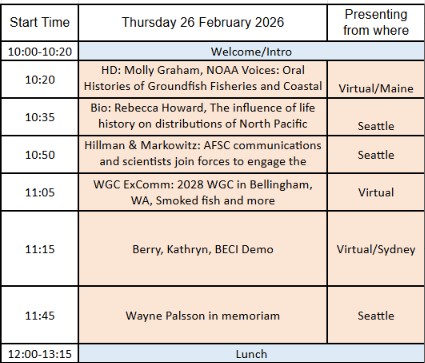
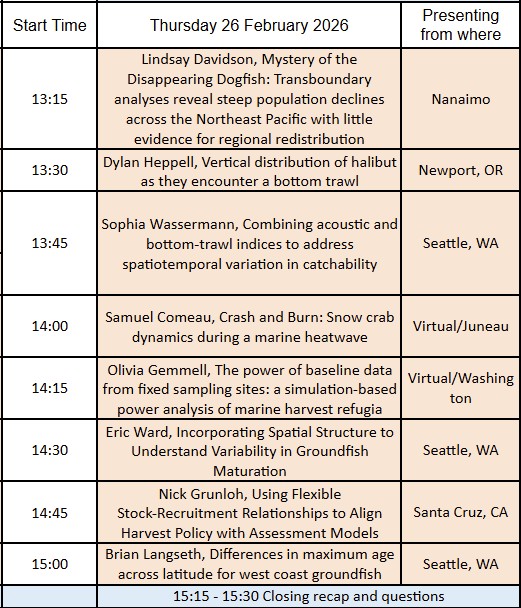
Thursday afternoon February 26, 2026. This session focuses on developments in groundfish stock assessment and fisheries monitoring activities that inform management. Encouraged topics are: methods for including ecosystem data directly into assessment models, novel survey designs and technologies for abundance estimation, innovation in the use of fishery data and local and traditional knowledge, and communication tools for bycatch reduction, catch validation, and/or assessment results. Management topics may include the use of socioeconomic data in quota setting, bycatch research in support of management, spatial tools, and electronic monitoring.
Session Chairs: Morgan Johnston (morgan.johnston@oregonstate.edu) and Ali Whitman (alison.d.whitman@odfw.oregon.gov)
Questions? Contact event organizers at WesternGroundfish@psmfc.org